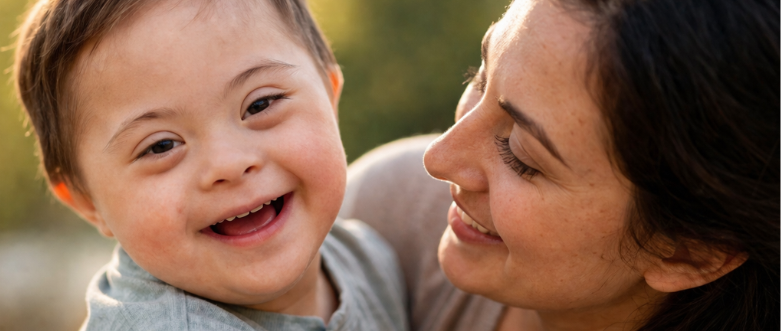
There was no noise in the room except the regular humming of the neonatal monitor. Sarah was sitting at the plastic bassinet looking at her two-day-old boy, Leo. An hour ago, a physician had been sitting on the edge of her bed, and had spoken of such terms as trisomy, muscle hypotonia, and developmental delays. He had given her a copy of clinical checklists and appointment schedules in a folder. But when Sarah saw Leo with his little hand around her pinky finger she could not see a medical case study. She saw a boy with the chin of his father and a most obstinately insurrectionary Milking-maidishness.
At that time the world was attempting to diagnosis her, however Sarah had other business in meeting her son.
This is the junction that thousands of families end up every year. The problem of Down syndrome is frequently treated in society in the form of the lack thereof: a disability, a retarded milestone, an alternative way. We are so much concentrated on the syndrome that we fail to see the human being in front of our eyes. We must go past the charts and the statistics and enter the world of living, full-coloured and deeply satisfying reality of people living with Down syndrome to have a real understanding of it.
Of the science, and without its enpuzzling terms, we would speak briefly before we proceed to discuss the soul. Down syndrome is actually just another genetic blueprint.
A majority of individuals are born with 46 chromosomes in each cell which is in pairs. Down syndrome is a condition that develops in a person when he or she possesses a complete or partial additional copy of chromosome 21. That is why this disorder is also called Trisomy 21.
This small fragment of additional genetic content is like a volume knob, which influences the development of the body and of the brain quite slightly. It may imply that it will take a more time to know how to walk or talk; it may imply that one is more prone to some health complications, such as heart defects or eye problems. But a plan is not a fate. A house is more than the architectural drawings, so is a person, way beyond the number of chromosomes.
The journey of most parents is commenced with a phone call or a silent conversation in a sterile room. It is of paramount importance to note that this is a time when it is usually characterized by a complicated "Grief of the Expected." Parents are not mourning over the child they are but the life they envisioned the child to have before they got acquainted.
Fear of the unknown, concern with social acceptance, the burden of a world that is not necessarily made to accommodate different exist. But when you talk to parents five or ten or twenty years later the story nearly always changes. The first shock gives place to an intense, protective love and, later, to a deep understanding: their child does not need to take care of him, he needs to listen.
Acceptance does not imply failure to see the challenges, it is just that the challenges are of secondary importance to the individual. Early intervention- physical therapy, speech pathology and occupational therapy- contributes in a colossal manner in contemporary outcomes. The brain is now known to be very plastic. The delays that we were previously terrified of can turn in to the alternative timelines with the appropriate help.
People have a long-standing myth that Down syndrome people are never sad but always happy or always angels. This stereotype is intended to be good, but is a limitation on its own. It deprives people of their right to be grumpy, frustrated, ambitious and complex.
The fact is far more entertaining. DS people are human beings that have the full range of emotions. What most people carry with them to their families and community however, is an amazing ability in emotional intelligence and presence.
There is a natural disposition of many people with Down syndrome to subvert social pretenses. They tend to cherish relatedness more than rank and honesty more than satire.
It seems that in a world hungry on faster, better, more, down syndrome life makes us want to slow down. It shows us to rejoice in the inch-stones, as well as the milestones.
Be it art, music or a special method of approaching a problem, the divergent thinking of Down syndrome often leads to the realization of a viewpoint that would have been missed by the normal thinker.
The fact that being diagnosed with Down syndrome tends to establish a low ceiling on what he/she can accomplish is one of the most destructive myths. The modern society and historical events testify to the contrary. We can witness a Down syndrome graduate leaving college, opening their own businesses, becoming wives and husbands, and becoming strong self-advocates in the international arena.
The trend to include students with disabilities in regular classrooms has been groundbreaking. It is not only about the student with Down syndrome acquiring academic skills but about the so-called ordinary students learning how to be emphatic, patient, and learn about the reality of human diversity. As a child matures with a peer who has Trisomy 21 next to them, they do not notice a diagnosis when that peer goes to work as adults they see a colleague.
The need to have friends and romantic love is common. Deep and long-lasting bondage develops between children and adults with Down syndrome. They explore in the politics of the elementary school playground, the inconvenience of teenage infatuations, and the fidelity of adult friendships. They desire to belong and not be "integrated" in benevolence, but be accepted as a fellow human being.
In order to really enter a world of real inclusion we should be able to break the outdated scripts and the clinical stereotypes that have been used to define Down syndrome. The society has long been functioning under the deficit model long enough when the condition was seen as a list of things that the person is unable to do, not as an alternative way of being.
The myth about the so-called permanent child is one of the most common ones: the belief that people with Down syndrome are eternal children who will never become independent. As a matter of fact, with the transition to the inclusive education and early vocational training, we are witness to a generation of adults who occupy competitive jobs, ride the bus, and reside in facilitated independent living units. They are not eternal children, but are adults, with their agency, politics, and love interests.
Another myth is that Down syndrome is a tragedy to a family. Nevertheless, the studies and experience often report otherwise. Siblings of a person with Down syndrome tend to say that they have more empathy, a greater sense of patience and are more down-to-earth in their understanding of what really matters in life. Moreover, the stereotype of always happy that appears to be a positive one is a kind of a restrictive myth. When we call someone always happy, we are taking away his/her right to a human experience. A person with Down syndrome will experience the same range of emotions as any other person: frustration, righteous anger, or even deep grief. We should give the person the honor of his own complexity in order to see him.
Lastly, the notion of having a ceiling on their potential needs to be challenged. It can be a young man who has become a licensed drone pilot or a woman who has opened her own boutique the only actual ceiling is that which has been made by the low expectations of society. When we cease to treat Down syndrome as a rare disease to be treated and instead of that, we acknowledge it as a natural constituent of human diversity, we pass through the clinical to the communal, we realize that a different life is not a life less experienced.
Families that have been affected by Down syndrome are normally sympathized by society. Sympathy is a peering emotion; it goes, I am sorry this happened to you.
Acceptance and inclusion is what we need.
It is the action of acceptance that is external. It is just a business owner recruiting a young girl due to her being the most suitable candidate. It even appears as though it is a coach ensuring that a player is a member of the team and not just a mascot. It appears as a neighbor that comes to the house to have a BBQ with the family without making a big fuss about the needs of the child.
The community needs to construct a ramp, not a wall, their role is to create community. There is no need to cure Down syndrome. We should address the obstacles which do not allow individuals with Down syndrome to access the world.
Getting back to Sarah and infant Leo, we see that the folder that the doctor gave Sarah was just a single piece of the puzzle. It had the what in it, but that could not possibly be the who.
The who is a young man who may be a lover of classic rocks or baker or the only person at his work place who knows the birthdays of all the people. The who is an individual, who will undergo heartbreak, pleasure, and the silent satisfaction of a job done.
Going outside what the diagnosis tells us, we discover that these differences are superficial, whereas the similarities are deep. We all want to be seen. We all want to be loved. It is in our desire to do something significant to this world.
The tragedy of Down syndrome is not in the fact that it is a variation of the human theme. It serves as a reminder that there is no right or wrong way of being human, that there are a thousand various ways of making the journey.
Once we are no longer obsessed with the extra chromosome, then we begin to see the extraordinary person. In that seeing we have a richer, kinder, and infinitely more beautiful world due to the diversity within it. Acceptance does not only mean opening a door to someone but it is to understand that after walking in, the entire room is a better place to be.
The diagnosis is never the end of the discussion, but the word.
Subscribe to our newsletter and get the latest updates and insights - straight to your inbox.